
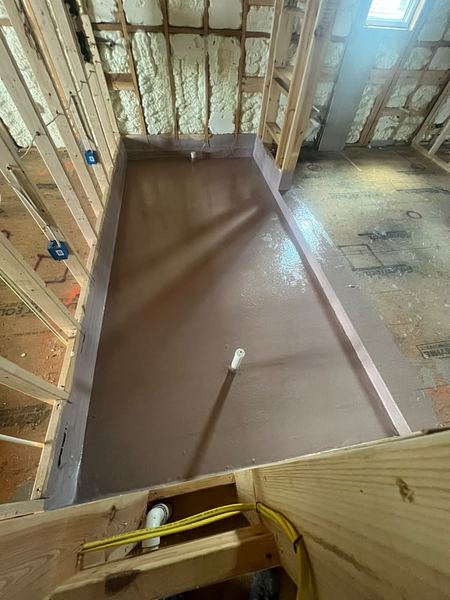
Most shower leaks do not start at the tile — they start at the pan. Here is what fails in a traditional mortar bed, and what a laminated pan does differently.
When a shower leaks, the tile usually gets blamed. It is rarely the culprit. Tile and grout are not waterproof and were never meant to be — water passes through grout routinely, and the system is designed on the assumption that it will. What is supposed to catch that water is the pan underneath. That is where the failures actually happen.
A traditional shower pan is a mortar bed sloped to the drain with a flexible sheet liner underneath it. The liner is the waterproofing. It is folded at the corners rather than sealed, clamped to the drain body with a metal ring and bolts, and then buried under a hundred pounds of wet mortar and tile.
That construction has three chronic weak points. The folded corners depend on a mechanical fold holding its shape for decades. The clamping ring depends on even bolt tension and an intact gasket, and it loosens as the assembly settles. And the liner itself is a thin sheet that anyone can puncture with a screw or a dropped tool during the rest of the build — with no way to inspect it once the mortar goes in.
There is a fourth issue that is less obvious: the mortar bed above the liner is not waterproof either. It absorbs and holds water. On a properly built pan, weep holes at the drain let that water escape. On a great many pans, those weep holes get packed with mortar during installation, and the bed stays permanently saturated. That is the source of a lot of persistent shower smells.
A laminated fiberglass pan removes every one of those failure modes. Mat and resin are applied in place as one continuous piece — sloped to the drain, carried up the curb and the walls, and bonded directly to the drain body. There is no fold, because nothing is folded. There is no clamping ring to loosen, because the laminate is bonded rather than mechanically compressed. There is no liner to puncture, because the structural surface and the waterproofing are the same layer.
It is also far more flexible in shape. Curbless entries, oversized footprints, benches, and irregular geometry are all straightforward when the pan is formed to your opening rather than ordered from a catalogue. And because we flood test every pan before it is covered, you know it holds water before the tile setter ever arrives — which is precisely the moment you want that certainty.