
Pavers, stamped concrete, and acrylic coatings all have a place. Here is an honest comparison of how each performs against fiberglass on a Florida pool deck.
There is no single right answer for a pool deck, and anyone who tells you otherwise is selling one product. What there is, is a set of trade-offs — and which one wins depends heavily on whether the deck sits on grade or over living space.
Pavers look excellent and are genuinely easy to repair, because you lift and replace individual units. What they are not is waterproof. Water passes straight through the joints by design. On a ground-level deck that is completely fine. Over a room, a garage, or any conditioned space, it is a non-starter without a separate membrane underneath doing the actual waterproofing.
Stamped concrete gives you a monolithic surface with good design flexibility, but concrete cracks. It always eventually cracks, because it moves and it has no tensile strength to speak of. Sealers slow water ingress and need reapplying every year or two in Florida sun. Once a crack opens, the sealer is bridging a moving joint, and it will not do that for long.
Acrylic and knockdown coatings are the most common answer on Florida pool decks, and they are affordable and comfortable underfoot. Their weakness is service life. They are thin, they chalk under UV, and they sit on top of whatever cracked substrate is underneath. When the concrete moves, the coating telegraphs it. Most need recoating every three to five years here.
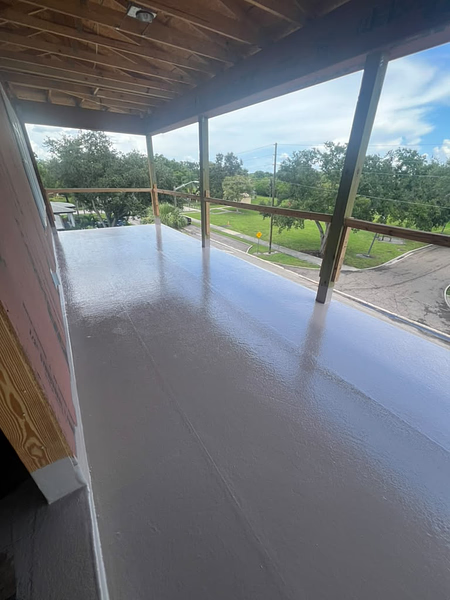
Fiberglass is more expensive up front than any of the above. What you buy for that is a continuous, structural, genuinely waterproof surface with non-skid built into the top coat rather than applied over it. It bridges minor substrate movement because the laminate has real tensile strength. It does not care about pool chemistry. And it can be re-coated rather than replaced when the finish eventually dulls.
The honest recommendation: on grade, in a dry situation, with a sound slab and a modest budget, a good acrylic system or pavers may be the smarter spend. Over living space, on an elevated deck, on a surface that has already cracked and been coated twice, or anywhere a leak lands somewhere expensive — fiberglass is the one that stops the problem instead of postponing it.